Posts

Caring

Image
Caring is one of the ten attributes of the learner profile. It is defined by the IB as: "We show empathy, compassion and respect. We have a commitment to service, and we act to make a positive difference in the lives of others and in the world around us." Relationships are at the heart of learning and teaching, welcoming and engaging learning environments and the well-being of the learner. Caring is a key component of how we connect to and treat others, so this attribute is embedded in all of our interactions in Kindergarten (and other grades!) Literature is key to promoting a caring community of learners. This is one of the bookshelves in Kindergarten. So many of the texts that connect to our increased awareness of diversity, inclusion, equity and justice have caring as an important theme for us to explore as a class. Text features such as plot, characters and illustrations provide opportunities for us to unpack related concepts such as kindness and respect.  This text was ...

Communicators

Image
Communicators is another attribute of the learner profile. The IB defines communicators by: We express ourselves confidently and creatively in more than one language and in many ways. We collaborate effectively, listening carefully to the perspectives of other individuals and groups.  An obvious connection for Early Years is the '100 Languages of Children', an expression used by Loris Malaguzzi, founder of the Reggio approach. It captures his image of the child and the capacity to express themselves in infinite ways.  Communicators, like many of the learner profile attributes, link to so many other aspects of the PYP including communication skills (as part of the AtLs), symbolic exploration and expression, voice (as part of agency) and sharing wonderings, theories and discoveries (as part of inquiry).  It has been interesting for me to reflect on examples of Kindergarten being communicators in the past few days, and as a result of some of the routines established since th...

Knowledgeable

Image
Knowledgeable is another attribute of the learner profile. The IB describes knowledgeable as: We develop and use conceptual understanding, exploring knowledge across a range of disciplines. We engage with issues and ideas that have local and global significance.  What strikes me is the connection between knowledge and understanding . Although they are different - knowledge being more binary and understanding being more associated with different levels of making sense of abstract concepts - knowledge provides the building blocks for understanding. Although the PYP is a transdisciplinary programme, the description above recognises the importance of knowledge in different disciplines. In Kindergarten, although many of the ideas we explore have global significance (play, structures, relationships...) we often explore these through very personal and local contexts so young children feel connected to these ideas.  We have a written curriculum that is driven by conceptual understandi...

Working Theories

Image
This blog post on working theories has 3 purposes: 1. To acknowledge a wonderful PD opportunity and encourage others to attend the next time it is offered 2. To recognise the importance of working theories in the most recent IB publication for early years 3. To reflect on my own understanding of working theories and consider next steps in my own learning journey.  Young Children as Thinkers and Theory Builders This webinar was developed by the always-inspiring team of Tania Lattanzio and Anne van Dam. This workshop over two consecutive Sundays is so well structured and honours its title with carefully sequenced engagements that balance modelled examples, discussion, independent learning and collaborative group thinking. There is a quality to Tania's and Anne's work that is in its own league. They are experienced educators themselves and weave magical moments of learning from their own practice with purposeful curated quotes and extracts from theory. There is an honesty to the w...

Risk-Takers

Image
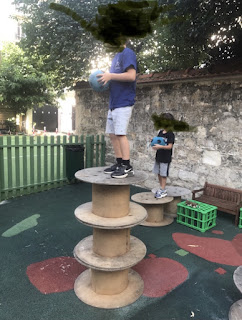
Risk-takers are another attribute of the learner profile.  The IB describes risk-takers as: We approach uncertainty with forethought and determination; we work independently and cooperatively to explore new ideas and innovative strategies. We are resourceful and resilient in the face of challenges and change.   It can be very useful to look at how organisations define terms as related concepts are often embedded and connected. In this definition, big ideas such as uncertainty, determination, independence, cooperation, innovation, resilience and challenge are all integral to risk-taking. Risk-taking is so important to Anji Play in China, it is actually one of their principles. The concept of risk-taking itself is subject to different interpretations and perspectives, and some prefer terms such as 'courageous'. Various educators label types of play differently and many link explicitly to risk-taking such as physical play, risky play, adventurous play and rough play. I...

Winsome unearths the roots of Kindergarten’s inquiries

Image
This post offers ways to use one text to provoke and reveal children’s inquiries - genuine curiosity, sincere questioning, authentic tension and heartfelt wonderings.  Just like Winsome, the children in my class have passed their fifth orbit around the sun. Who is Winsome? Let’s find out how she connected Kindergarten to the concept of curiosity, the craft of bookmaking, the mindset of wondering and the magic of imagination -  and unearthed the roots of their inquiries. The Wonder of Winsome is a picture book recently published by Kath Murdoch, perhaps best known for being a true advocate of inquiry as pedagogy. Winsome, the main character in the text, arrived in book form in Paris recently, pretty much at the same time as I was inquiring into a specific workshop I wanted to attend (which itself led to inquiries about and connections to Paris and Rufus Wainwright!) What follows is a series of learning opportunities over the course of a week, sparked by Winsome! What happened W...

Open-Minded

Image
Open-minded is one of the ten attributes of the learner profile. The IB describes open-minded as: We critically appreciate our own cultures and personal histories, as well as the values and traditions of others. We seek and evaluate a range of points of view, and we are willing to grow from the experience.  Strategies used so far in Kindergarten to foster a sense of being open-minded: Modeling - The classroom assistant and I have been intentional and explicit in modeling open-minded behaviour, choices and language. This has been through showing genuine curiosity in the children's families, cultures, interests and experiences outside of school. We ask open-ended questions that deliberately invite and explore different perspectives and reflect openly on how different thinking have helped us to learn new ideas.  Literature - We have deliberately bought texts to read aloud that reflect the diversity of families and cultures we have in the class. We have sought literature that ex...