Posts

How do we describe the young children we teach?

What words do you use to refer to the young children we teach in Early Years? In the PYP, Early Years children are 3-6 year olds.  Children? Students? Little ones? Kiddos? Learners? Littlies? Kindies? Small people? Kids? Young people? Littles? Youngsters? Pupils? Other words? What inferences might people make about young children and our views based on the words we use to describe them? Does it matter? Is it enough to have good intentions?  Why might these differences exist? Culture? Our image of the child? ... What terms do we use as we talk to the children themselves?  Is our language inclusive?  What do our choices reveal about how we view children, learning and our own roles as adults? 
The Role of the Adult in Play

Image
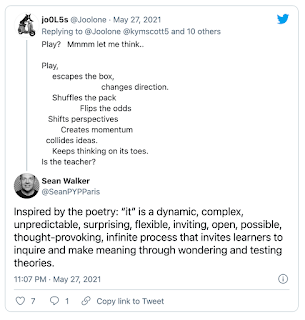
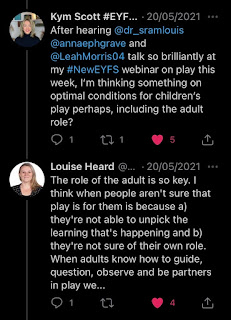
What is the role of the adult in play? This is something that really intrigues me and an inquiry that will evolve and deepen once I teach Kindergarten in September. Reflecting on what I have been reading and viewing is allowing me to pull out big ideas that resonate with me right now and will act as "success criteria" for my role next year.  I was really struck by a few tweets in a thread I started: It is often useful to consider what something is not to clarify and deepen an understanding of what something is . The idea of director resonates with and contradicts the notion of play based on choice and intrinsic motivation. Control is an important variable in learning and teaching. Who has the control? In a recent webinar, Lisa Murphy promoted the idea of us as adults controlling the environment and not the child. I think there are opportunities for children to make decisions and take ownership of their learning spaces, too.  The idea of a distractor connects so well to what ...

What might play look like?

In an effort to further unpack the complexity of play, I have thought about my ongoing visits to Early Learners (3-5 year olds) and my own experiences of observing children play, to think about the vast range of things children might do as they play. In considering what play might look like, I have made considered concepts children might inquire into and made explicit connections between a child's play, thinking, inquiry and understanding. Play is anything but trivial! Play and being playful can be rather abstract, so these concrete examples might help to clarify, deepen and broaden our thinking.  In their choices, children might engage in dramatic or imaginative play. This might include small world play or taking on different characters. Children might be pretending, fantasising, imagining, role playing or changing voices. Concepts explored could include character, performance, setting, storytelling, fantasy, imagination and empathy. Learning spaces that encourage this play might ...

What is Play?

Image
Play is central to learning in the Early Years. The PYP includes 3-6 year olds as Early Years, so I have been inquiring into what play actually means. I have enjoyed asking people, engaging in Twitter chats, viewing webinars and reading articles about play.  From Principles into Practice (published by the IB) states, "Play involves choice, promotes agency and provides opportunities to inquire into important concepts and personal interests." It also reminds us: "Play is the primary driver of inquiry."  Often, I read descriptions and characteristics of play more than a definition. This in itself is important as it recognises the complexity of play as a pedagogical approach, a process, an opportunity, and (as stated by at least two wise educators) a state of mind.  Play does not always look the same. I have seen continuums of play, but I am starting to 'play' with the idea of a tangled web that includes the concept of play, different types of play, 'play...

Maximising Opportunities for Play

This past week has been exciting as I have had conversations with the VP (Vice Principal) for Organisation, principal and the future PYP Coordinator about maximising opportunities for play in Kindergarten next year.  These weekly posts document my inquiry - sometimes framed by a question, a wondering, a theory to propose and test, or a statement of intent to unpack and explore. They tell the story of playing with ideas and possibilities... which of course will evolve in September with the reality of teaching a specific group of learners.  We have decided to move away from pre-determined lines of inquiry. Units will have a conceptual focus and the lines of inquiry will be crafted in negotiation with the Kindergarteners. After initial provocations, we will observe to see what they are curious about and want to spend time exploring in their play. Observation, documentation and responsive planning will be key here and, no doubt, feature in future blogs.  The schedule for sing...

Connecting with Next Year's Kindergarten Students

This week, I have been lucky enough to visit the Early Learners and see my future Kindergarten students in action. I have visited their learning space three different times to have a glimpse into their world and make initial connections.  The aim has been to see the children at play and connect with them so that I am not an unknown face in September, and they are not unknown to me.  In conversation, and through observation, I have seen and heard about their interests, siblings and weekends; the patterns they have been creating; the diaries being made; the magic bubbles of the soapy water and the friends they have.  In their learning space, I have had chance to speak to the current teachers and assistants to learn a little more about each child's personality, language profile, approach to learning and family.  One child is fascinated by numbers. At first, he was reluctant to engage with me. Then I took my iPhone and showed him the calculator. He declined to take it. I...

A New Job!

I have toyed with the idea of a blog for a while. The plan with Ruby Tuesday is to offer what some may perceive as a gem each and every Tuesday as I embark on a new learning journey, sharing some of my adventures and insights along the way.  Let's go back to last Tuesday!  I found out I was successful in my application to lead the Early Learners and Kindergarten team at my school next year, and teach Kindergarten for the first time!  Let's just say my mind is alive with ideas! I have been thinking about the big picture of play, different types of play in action and the notion of being 'playful'. I have started to think about the materials that will transform a classroom into an engaging learning space that promotes play and provokes curiosity. I have reached out to wise and inspirational educators I respect that have years of experience in early childhood.  I am conscious of ensuring uninterrupted time for play both indoors and out. Looking at units of inquiry, I hav...